The Commitments of Traders (COT) report is going twice weekly. On 27 October 2026 the U.S. Commodity Futures Trading Commission (CFTC) announced that it will publish the report two times a week (a semi-weekly COT report) instead of once, with a shorter delay between the day the positions are measured and the day they become public. The change is planned for the end of 2026; the CFTC has not given an exact start date.
This article sets out what was announced, the new schedule next to the current one, what the switch means for anyone who reads COT data, the questions the CFTC has not answered yet, and what COT-Reports.com will do. Everything about the change comes from the CFTC’s press release; where the CFTC has not said something, we say so.
What the CFTC announced on 27 October 2026
The announcement came in CFTC press release 9316-26, issued on 27 October 2026 by CFTC Chairman Michael S. Selig. Its core is simple: the COT report, published once a week for decades, will be published twice a week. The CFTC’s stated timing is “by the end of 2026” — a goal, not a date. No first release day was named.
The new schedule has two publications per week. Positions as of Monday will be published on Wednesday, and positions as of Wednesday will be published on Friday, both at 3:30 p.m. Eastern Time. As a result, the reporting lag — the time between the day the positions are measured and the day the public sees them — falls from three days to two.
The decision did not come out of nowhere. On 30 April 2026 the CFTC published a Request for Comment on possible changes to the COT program, more frequent publication among them. The press release links the new schedule to that consultation and to the feedback the agency received from the agricultural community, one of the report’s oldest audiences.
The rollout is led by the CFTC’s Division of Data, which, according to the press release, will deliver it through the modernization and automation of how the report is produced.
The new COT release schedule
Under the new schedule there are two snapshots a week, each published two days after it is taken:
- Data as of Monday → published Wednesday, 3:30 p.m. ET (a two-day lag)
- Data as of Wednesday → published Friday, 3:30 p.m. ET (a two-day lag)
The release time stays the one COT readers already know: 3:30 p.m. Eastern Time. Eastern Time is UTC−5 in winter (EST) and UTC−4 in summer (EDT), so a release lands at 20:30 UTC in winter and at 19:30 UTC in summer. In Central Europe that is 21:30 local time for most of the year, in winter (CET) and in summer (CEST) alike; for a few weeks each spring and autumn, when the United States and Europe change their clocks on different dates, it is 20:30.
Holidays will still matter. Today, a U.S. federal holiday in the days after the snapshot moves the release, usually to the following Monday. The CFTC has not yet said how holidays will shift the Wednesday and Friday releases. Our release schedule page follows the CFTC’s published calendar and will show the new dates once the CFTC publishes them.
Current schedule vs new schedule
Side by side, the current weekly schedule and the announced twice-weekly one:
- Releases per week: one today → two under the new schedule
- Snapshot (as-of) days: Tuesday → Monday and Wednesday
- Release days: Friday → Wednesday and Friday
- Release time: 3:30 p.m. ET → 3:30 p.m. ET (unchanged)
- Lag from snapshot to release: three days → two days
- Reports in a year: about 52 → about 104
- In force: today → by the end of 2026, no exact date announced
Until the CFTC switches over, nothing changes: the report keeps coming out on Friday at 3:30 p.m. ET with positions as of the previous Tuesday. Why the current schedule works that way — the collection, validation and anonymisation that fill the days between the snapshot and the release — is explained in our article on the Friday release and the three-day lag.
What changes for someone who reads COT data
The data itself — who holds which positions, by trader category, in each market — keeps its meaning. What changes is how often it is sampled and how quickly it becomes public. That has a few practical consequences for anyone who works with the numbers. They are facts about the data, not views about any market.
Two snapshots a week. Each market will have a Monday reading and a Wednesday reading every week instead of a single Tuesday reading. Changes in positioning that happen inside a week can appear in the published data, where today only the net result from one Tuesday to the next is visible.
A shorter lag. Two days between the snapshot and the release instead of three. The positions read on a Wednesday or a Friday afternoon will be one day more recent than the Tuesday positions read on a Friday afternoon today.
Uneven intervals. The two snapshots are not evenly spaced. From Monday to Wednesday is two days and two trading sessions; from Wednesday to the next Monday is five days and three trading sessions (Thursday, Friday and Monday). The change between two consecutive reports will therefore cover a short interval and a long one, in turn. When two changes are compared, it helps to know which interval each one covers.
“Weekly change” becomes “change since the previous report”. Today the change column of a COT table is, in practice, a week-over-week change, because consecutive reports are one week apart. With two reports a week, the change from one report to the next covers half a week or a little more. A week-over-week comparison remains possible — a Wednesday report against the previous Wednesday report, or a Monday against the previous Monday — but it is no longer the same number as the change since the previous report.
Lookbacks measured in reports versus weeks. Many COT measures look back over a fixed window, such as 26, 52 or 156 weeks for the COT Index. Once there are two reports a week, a window defined as a number of reports covers half the calendar time it covers today (52 reports become about six months instead of a year), while a window defined in calendar time holds about twice as many data points (one year becomes about 104 reports instead of 52). Neither definition is wrong, but they no longer give the same result, so a measure has to state which one it uses.
A change of rhythm in the series. The history published so far is weekly and anchored on Tuesday. After the switch, new data will be twice weekly and anchored on Monday and Wednesday. A long chart will therefore join two sampling rhythms at the changeover date. Whether the CFTC will restate or extend past data in the new format is one of the open questions below.
What is not known yet
The press release fixes the direction and the new rhythm, not every detail. At the time of writing, the CFTC has not said:
- The exact start date. Only the stated goal: by the end of 2026.
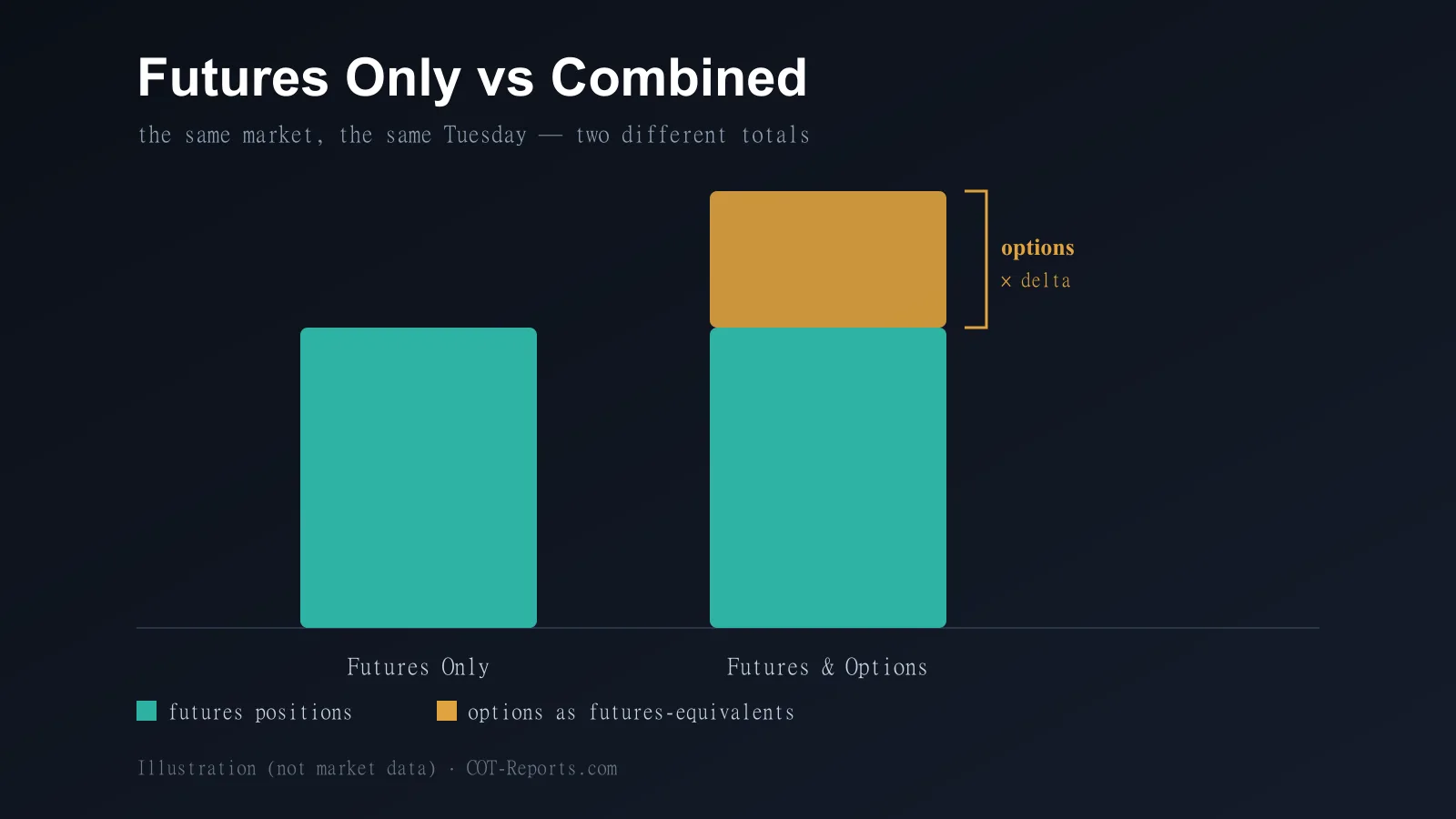
- Which reports and versions. The CFTC publishes several COT report families — Legacy, Disaggregated, Traders in Financial Futures (TFF) and Supplemental — three of them in both a Futures Only and a Futures & Options Combined version. The announcement speaks of the COT report and does not list them one by one.
- What happens to the history. Whether past weekly data stays as it is, or is restated or extended in any way.
- How holidays will move the new releases. Today’s rule moves a delayed release to the next business day, usually a Monday; the twice-weekly calendar has not been published yet.
- Whether the files themselves change — their formats, their columns or their download addresses.
Until the CFTC publishes those details, any precise answer to these questions would be a guess. We will update this article when the CFTC says more.
Want to know as soon as the CFTC sets the date? Subscribe to our free weekly COT email at the end of this article: we will tell you there first, along with what changes on the site. A free account goes further: up to 10 years of history on the free report pages.
How COT-Reports.com is preparing for the twice-weekly report
COT-Reports.com publishes every COT report as the CFTC releases it, and that will not change. When the report comes twice a week, each release — on Wednesday and on Friday — will be on the site as soon as the CFTC publishes it. Our tables and charts are built from the CFTC’s own files, so the move changes how often new data arrives, not where it comes from.
We are preparing the site so that the switch needs nothing from its readers:
- Automatic detection. The site already recognises the change by itself: as soon as the CFTC publishes two reports closer together than the weekly schedule ever puts them, our systems flag the new schedule.
- Every report kept. The tables will keep every report and show the change since the previous report, so no release is skipped or merged into another.
- Like compared with like. Long-range statistics — the 3-year ranks, the history and the heatmap — will keep comparing positions over the same calendar span, so 40 years of weekly history stay comparable with the new twice-weekly data.
- Time periods stay calendar time. A period such as 3 months or 1 year will keep meaning 3 months or 1 year of the calendar, not a fixed number of reports.
- The calendar follows the new days. The release schedule page, the countdown to the next report and the “Released on” lines will follow the Wednesday and Friday releases once the CFTC publishes its new calendar.
Until the switch, the release schedule page shows the current Friday calendar, which is the one in force. Today’s report and the history behind it are on the site now: the Latest COT Report pages show the newest release for every market, and COT Premium adds the full history and the CSV export, for anyone who wants to study the long series on both sides of the changeover.
Sources
- CFTC — press release 9316-26 (27 October 2026): the COT report to be published twice weekly (opens in a new tab)
- CFTC — Commitments of Traders (opens in a new tab)
- CFTC — COT Release Schedule (opens in a new tab)
COT-Reports.com is independent and not affiliated with the CFTC.