COT and Open Interest: Two Datasets Behind Every Futures Market
Open interest and the Commitments of Traders report are the two public datasets that shape how futures markets are described. How they complement each other.

pen interest and the Commitments of Traders report are the two public datasets that almost every serious description of a futures market is built on. They are easy to confuse — both deal with positions held in contracts — but they answer different questions, and they are published on very different timetables.
Open interest, briefly
Open interest is the total number of futures contracts that exist for a given market at the end of a trading day. It is published daily by the exchanges and it is available the same day. It tells you how much capital is committed to the market at a given moment, regardless of who is holding it.
Volume and open interest are often confused. Volume counts how many contracts changed hands during the session — a noisy, high-frequency number. Open interest counts how many positions survived the session — a slower, cleaner measure of market engagement.
COT, briefly
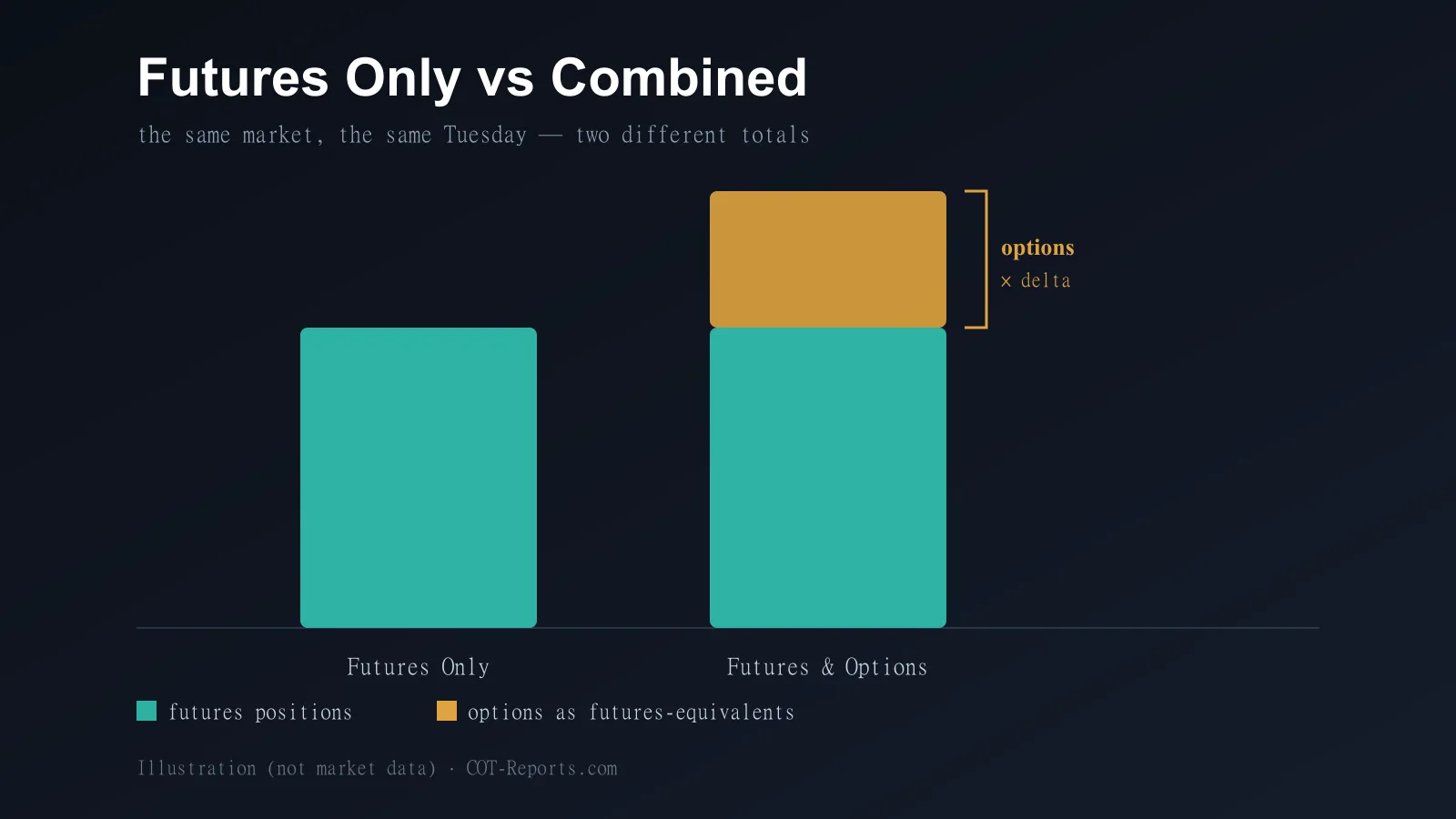
The COT report takes the same total open interest that the exchange reports and breaks it down by type of trader — who is holding those positions and on which side of the market. It is published once a week, on Friday, and reflects positions as of the previous Tuesday close. The report does not tell you anything the exchange is hiding; it tells you things the exchange never publishes at all, because the exchange does not organise its own data by trader category.
Why observers look at both
Open interest answers a quantity question: is money flowing into this market or out of it? COT answers a composition question: whose money is it? Neither alone is enough to form a complete picture, which is why most experienced futures commentary refers to both datasets in the same breath. A rally on rising open interest looks one way; the same rally looks quite different when the COT report shows it was driven by short-covering rather than new speculative buying.
Both datasets are public. Both are free. The work is in building the habit of checking them — and in knowing which question you are trying to answer before you open the file.